
A Strong Home Starts
Long Before the Concrete Is Poured
Many people think building a concrete foundation is as simple as pouring concrete and waiting for it to dry. The reality is very different — and understanding that difference is why some foundations last generations while others fail in years.
Every solid foundation begins with careful planning, proper site preparation, and skilled craftsmanship. Before the concrete truck even arrives, the most critical work has already been done. What the crew completes in those pre-pour hours determines how the slab performs for the next 50 years.
This is where the real work begins — and where inexperienced contractors cut corners that cost homeowners thousands of dollars later. A solid foundation isn’t built the day of the pour. It’s built in the days before it.
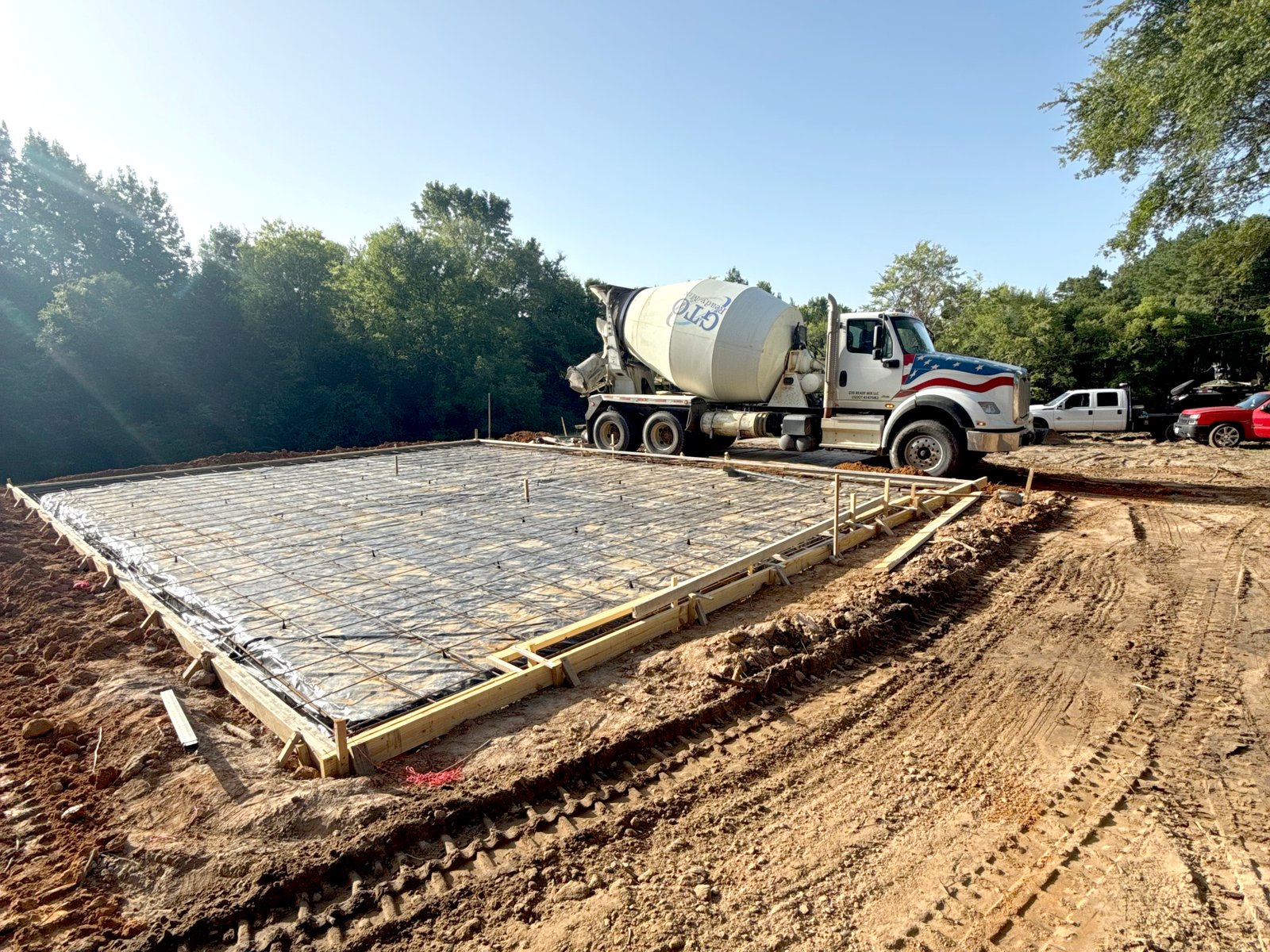
- Preparing and leveling the ground — The subgrade is graded, compacted, and checked for maximum stability. Soft spots, clay pockets, or fill areas are addressed before they can become foundation problems.
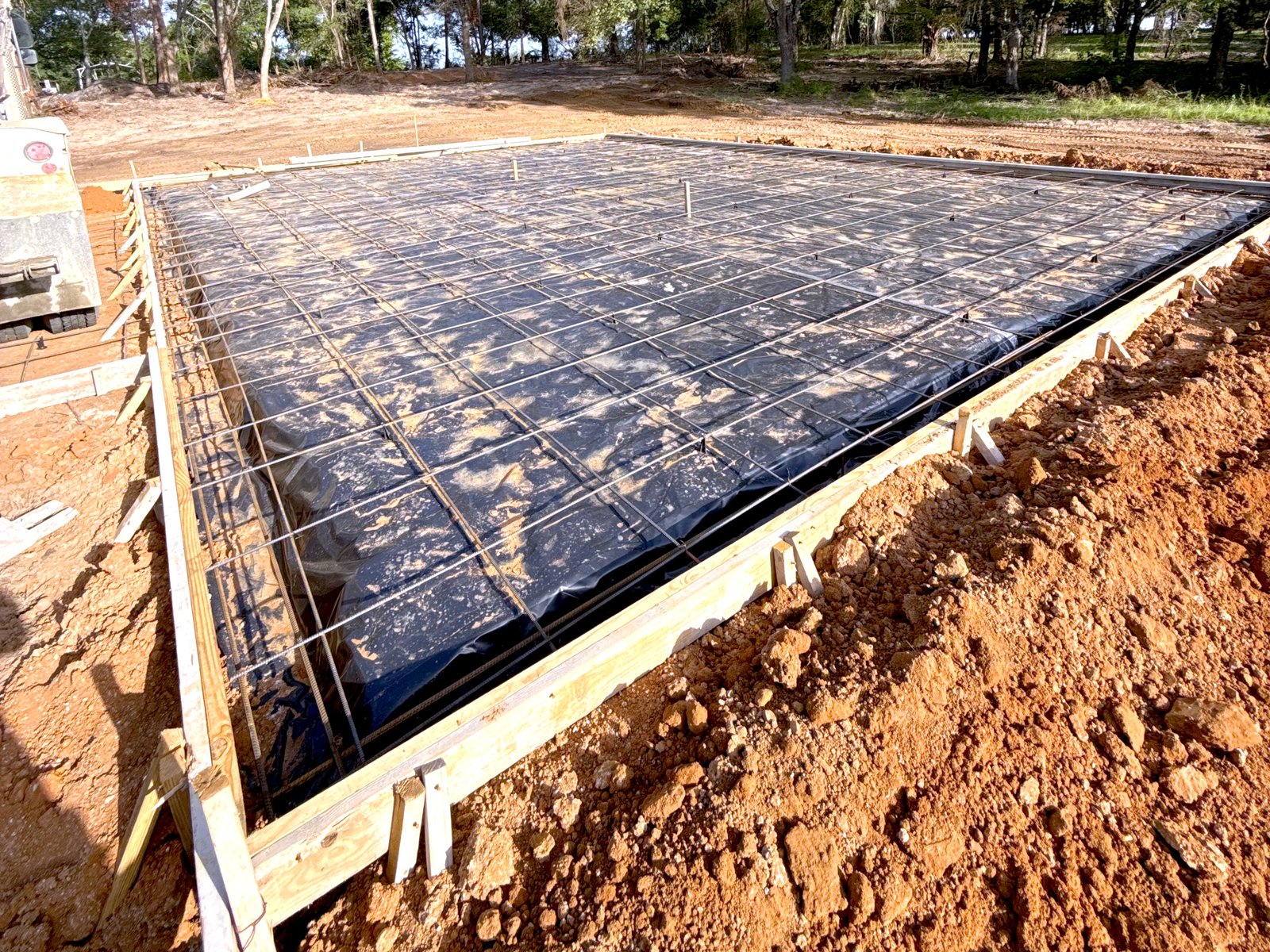
- Installing a moisture barrier — A vapor barrier is placed beneath the slab to protect the foundation from ground moisture that would otherwise migrate upward over time, weakening the concrete from below.
- Placing and securing the reinforcing steel (rebar) — The rebar grid is cut, tied, and positioned at the correct depth within the slab. This internal structure is what transforms a concrete slab into a structural element capable of carrying load.
- Building and checking the forms — Perimeter forms are set to precise dimensions and elevation. Every corner is squared, every board is staked. The form defines the shape, the edge, and the thickness of the final slab — errors here are permanent.
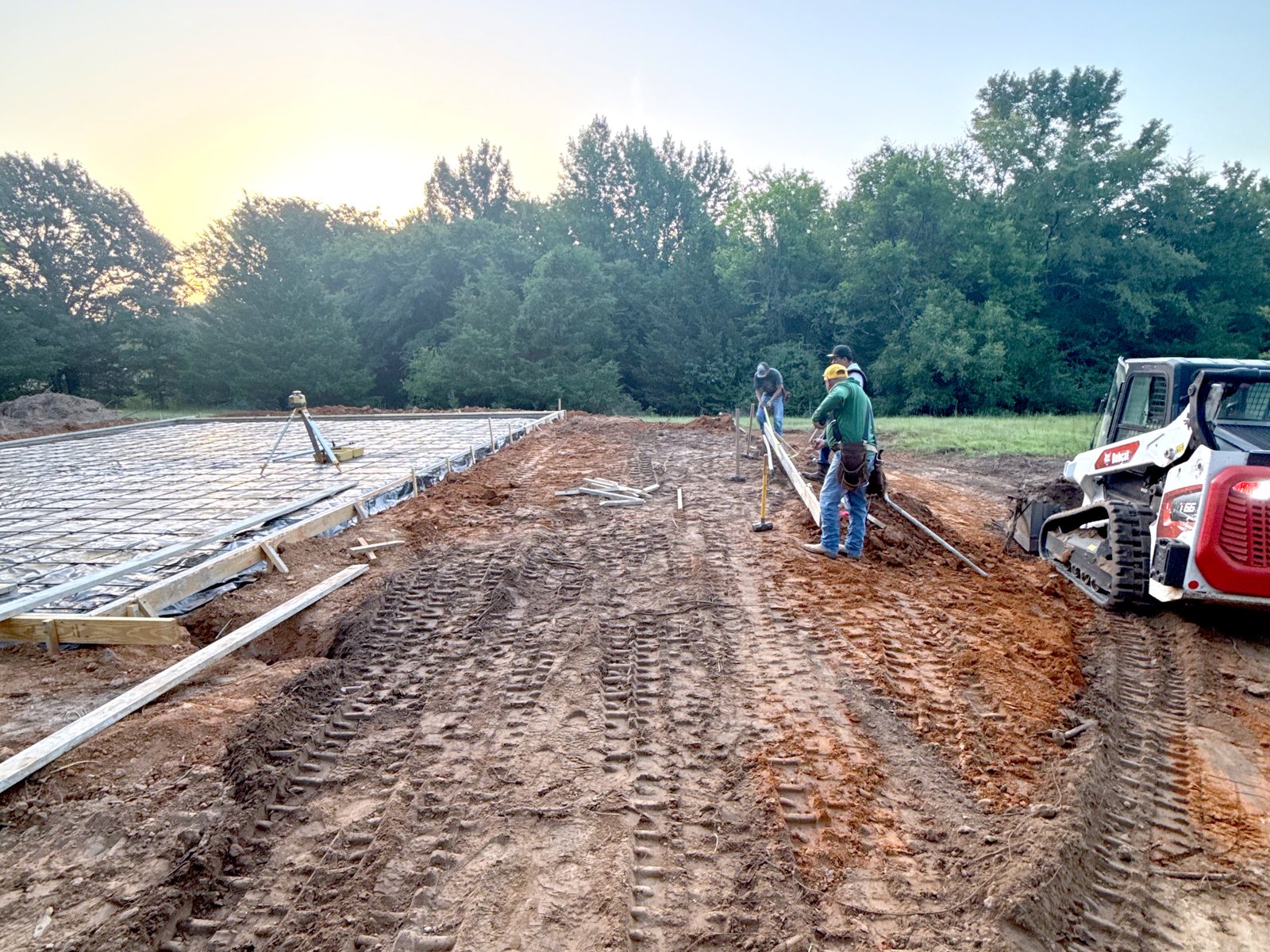
Once concrete is placed, nothing beneath it can be adjusted. Soft ground, missing rebar, or improperly set forms cannot be fixed after the pour. The only option at that point is demolition and a complete restart. Getting this phase right the first time isn’t attention to detail — it’s the entire job.
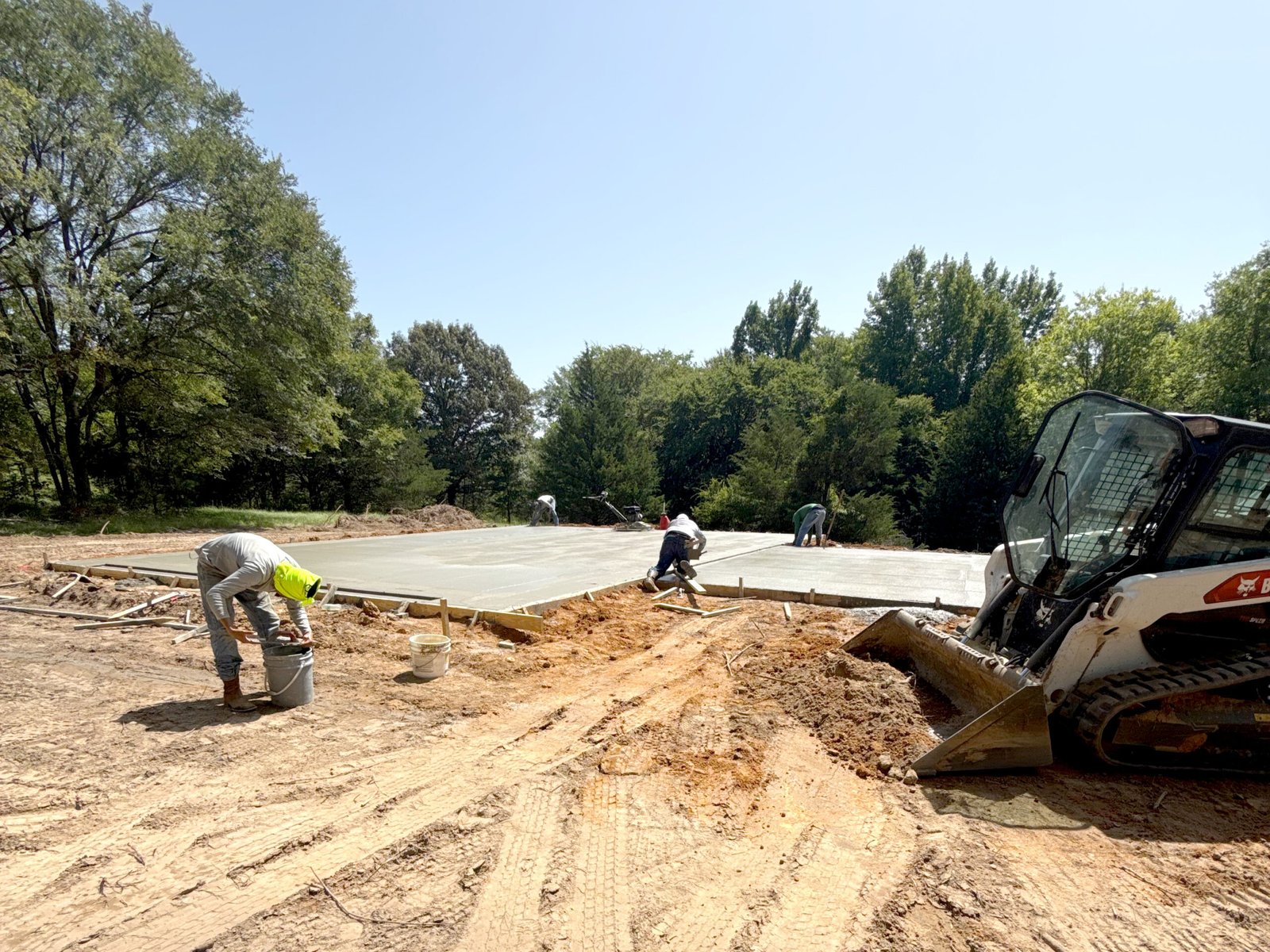
Once the concrete is delivered, the work continues with the same level of precision. The pour is a high-intensity, time-sensitive operation — the entire crew has to move in sequence, because once concrete is placed, the working window for corrections is narrow.
- Controlled placement — Concrete is poured in sections, not all at once. The crew directs the chute to avoid segregation of the mix and ensure consistent coverage across the entire slab.
- Screeding and leveling — The surface is struck off to the top of the forms using a screed board, establishing a flat, even plane that matches the set elevation at every point.
- Finishing — Bull floats and hand trowels close the surface and bring the cream to the top. The texture is then applied — broom, trowel, or aggregate — depending on the project specification and the homeowner’s selection.
- Timing — The crew reads the concrete continuously, working the surface at each stage of its set cycle. Move too early, and the surface won’t hold. Move too late, and finishing becomes impossible. Experience is what makes this call right.
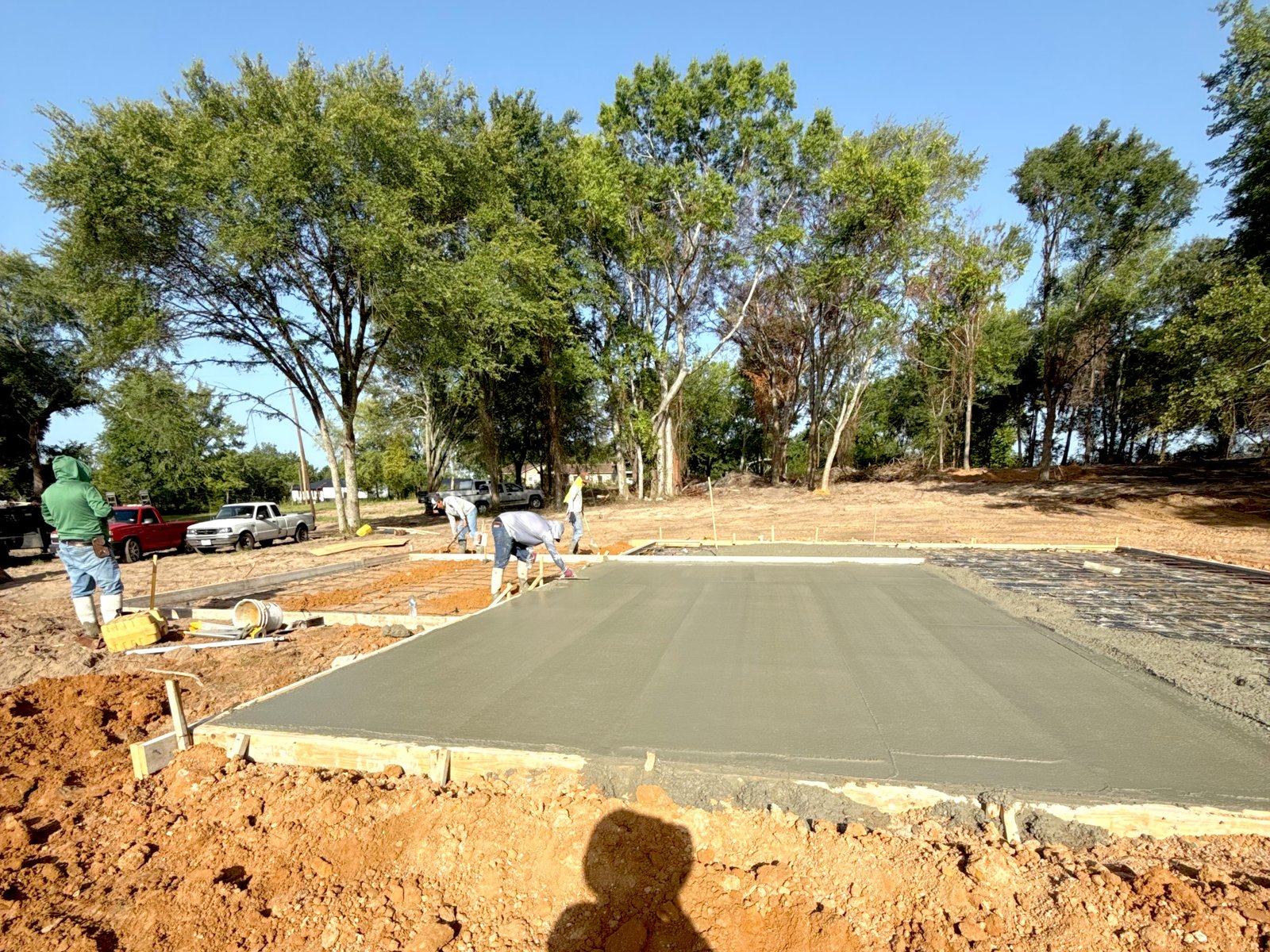
Our crew carefully places, levels, and finishes the concrete to create a smooth, durable surface that meets the highest quality standards. This isn’t a phrase — it’s a sequence of decisions made under time pressure, on every pour, by a team that has done this work long enough to know exactly what “right” looks and feels like.
After the concrete has properly cured, we remove the forms and inspect every detail to ensure the foundation is ready for the next phase of construction. This step is often skipped or rushed by contractors who have already moved on to the next job. We stay.
- Edge and corner condition — Form removal is done carefully to avoid chipping or damaging the slab edges. Any form-release residue is cleaned from the concrete surface.
- Surface flatness and elevation — We verify the finished slab meets the elevation specified at the start of the job. A foundation that is out of level by even a small amount creates compounding problems for every trade that follows.
- Visual inspection for anomalies — We look at every section of the slab — not just a walk-around glance — checking for surface issues, checking that control joints were placed correctly, and confirming the slab is ready to receive load.
- Curing confirmation — We verify the concrete has reached the required strength milestone before releasing the slab for framing or next-phase construction.
Engineering, Preparation, Precision, and Teamwork
At SMG Concrete & Dirt Work, we know that a foundation isn’t just concrete. It’s the engineering of the ground beneath it. The preparation of the forms around it. The precision of the rebar inside it. And the teamwork that brings every step together on pour day — under the sun, on deadline, with no room for error.
Every step matters because the strength of your future home depends on what happens before, during, and after the pour. When you choose SMG, you’re choosing quality craftsmanship, attention to detail, and a foundation built to carry whatever you build on top of it — for as long as you need it to stand.
Built on Solid Ground.
Designed for Generations.
SMG Concrete & Dirt Work · Tyler, TX
on Solid Ground?
Tell us about your project. We’ll walk you through every phase — from site prep to final inspection — and give you a written estimate with no surprises.
Or call us directly: (903) 780-3125 · Mon–Fri 9AM–4PM · Sat 9AM–12PM