
What Is Grading
in Concrete
The ground beneath your slab determines whether your concrete lasts 40 years or fails in five. Here’s what grading actually means — and why East Texas clay makes it non-negotiable.
Most homeowners think about concrete in terms of what gets poured. What they rarely think about is what happens to the ground before the first yard of mix arrives — and that omission is exactly why so many slabs crack, shift, flood, or fail within five years. Grading is the step that determines where water goes when it rains. Get it right, and your concrete can last 40 years. Skip it, and you’ll be calling a demolition contractor inside a decade.
The Definition Most Contractors Skip Over
Grading, in the context of concrete, refers to the process of shaping and sloping the ground surface to achieve two outcomes: correct elevation and controlled drainage. It is not simply flattening the ground. It is not just removing vegetation. It is the precise manipulation of the soil profile so that the surface — and everything poured on top of it — performs exactly as designed.
A properly graded site has been excavated to the correct depth, shaped to direct water away from structures, and prepared so that the subgrade underneath the slab is uniform, stable, and load-ready.
- Leveling means making a surface flat — equal elevation across the area.
- Grading means making a surface correctly sloped — intentionally not flat, because flat concrete is a drainage problem waiting to happen.
- Water on a perfectly flat patio has nowhere to go. It pools, seeps into control joints, and accelerates surface deterioration.
- A graded surface directs water toward a drain, a slope, a yard — anywhere that isn’t under the structure or against a foundation wall.
For most residential concrete — driveways, patios, walkways — the standard slope is a minimum of 1/8 inch per linear foot (1–2%). That’s enough pitch to move water without creating a surface that feels noticeably tilted underfoot. This is not a detail a homeowner can eyeball. It requires a laser level, grade stakes, and a contractor who understands how water moves on your specific property.
Why Grading Is Phase Four — Not an Afterthought
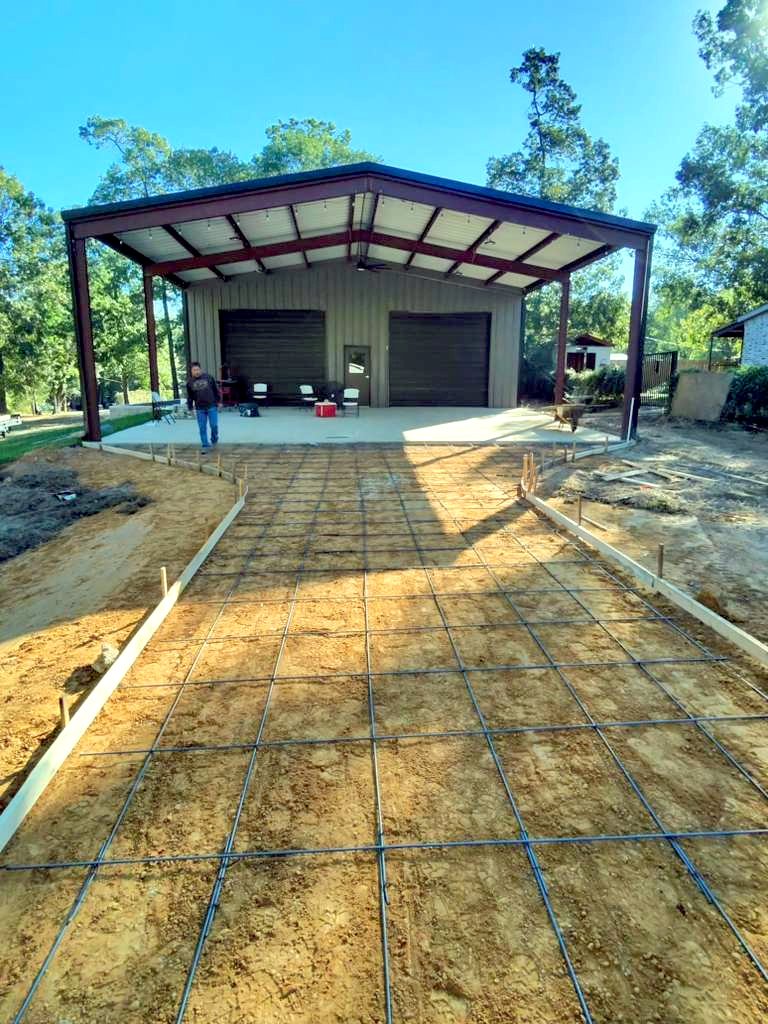
If you’ve read the 7 phases of a concrete project, you know that site preparation is Phase Four — the step that happens after the contract is signed and before the pour is ever scheduled. Grading sits at the center of that phase. It is the work that is largely invisible to the homeowner, carried out before any concrete arrives, and yet it is the single most consequential decision made during the entire project.
A contractor who rushes through site prep to get to the pour is building your slab on an assumption: that the ground beneath it will behave the way they hope. In East Texas, that assumption fails — often, and at significant cost to the homeowner.
A crew that grades in an hour and calls for the concrete truck is gambling with your slab. A crew spending a full day on grading before any concrete is ordered is doing the job correctly. Time on site prep is not inefficiency — it’s quality.
What Happens When the Ground Isn’t Graded Properly
The failure modes are predictable. They’re also cumulative — each one accelerates the others.
East Texas Clay Makes This Non-Negotiable
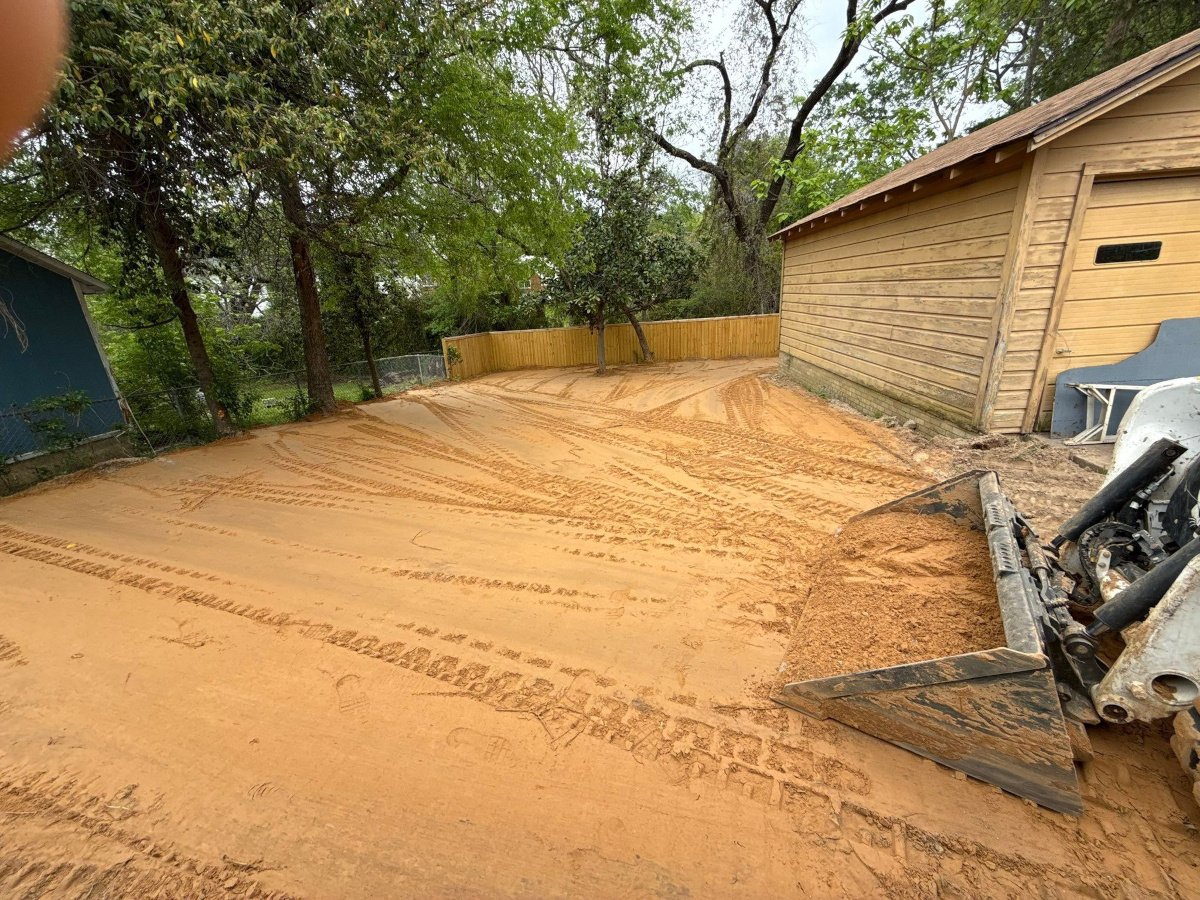
Smith County soil is predominantly heavy clay. Clay is not a stable base. It absorbs moisture and expands. It dries out and shrinks. In East Texas, that cycle runs hard: wet winters, dry summers, periods of drought followed by heavy rain events.
Without proper grading to direct surface water away from the slab perimeter, moisture finds its way under the concrete. Once it’s there, physics takes over. A crew that has worked East Texas soil understands this. A crew that hasn’t — or one cutting corners on prep time — will grade by eye, skip the compaction step, or underestimate the slope needed to handle a real rainfall event. The homeowner won’t know the difference until the concrete is in the ground and the first hard rain falls.
From the initial estimate to final walkthrough — understand every step before you hire, so you know exactly what a professional process looks like and what questions to ask at each phase.
Read the Full GuideWhat Proper Grading Looks Like in Practice
Walk onto a job site where grading is being done correctly and here’s what you’ll see: excavation equipment moving material with precision, grade stakes set at measured intervals across the entire area, and a laser level or transit being used to verify slope before a single form is placed.
- Industry standard for residential concrete: 1/8 inch per linear foot (approximately 1% grade)
- Many contractors aim for 1.5% to 2% to provide margin for minor settling over time
- For a 20-foot driveway apron: roughly 2.5 to 5 inches of total elevation change from high point to low point
- A correctly graded surface does not feel like a ramp — it feels flat underfoot while moving water efficiently during rain
Grading for Driveways vs. Patios vs. Slabs
The grading requirement changes based on the project type, adjacent structures, and drainage context.
Grading and the Subgrade: Two Steps That Work Together
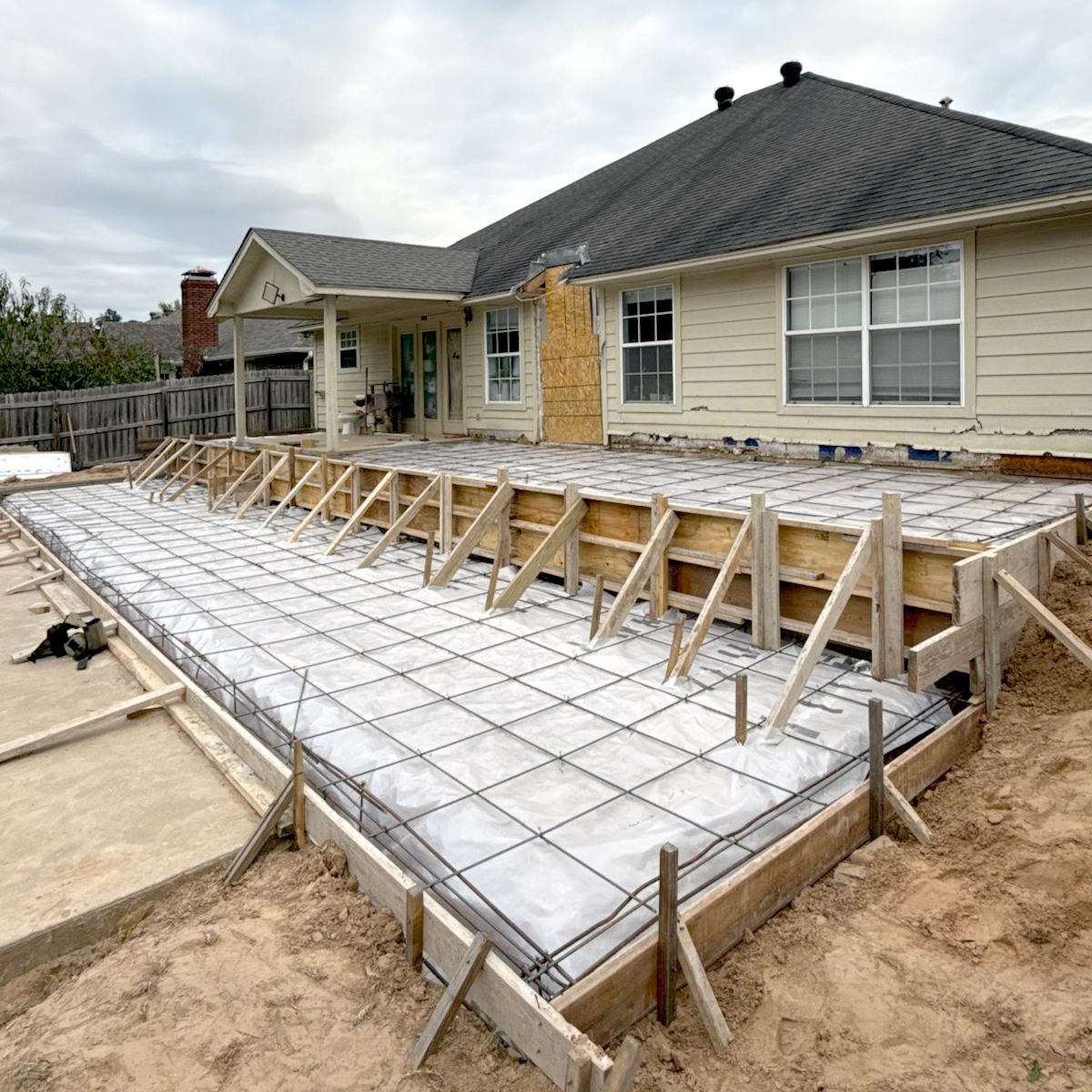
Grading establishes the shape of the ground. Subgrade preparation is what happens next — and the two are inseparable. A graded surface that hasn’t been properly compacted and stabilized will settle independently under the load of the slab, undoing the drainage work and creating differential movement.
Once the soil has been shaped to the correct grade, it needs to be mechanically compacted — typically with a plate compactor or roller — to densify the material and reduce future settlement. Native East Texas clay, even when properly graded, can continue to shift under a slab if it hasn’t been compacted to a stable density. The ground should not depress significantly under foot pressure and should sound solid when struck.
The gravel base layer — crushed limestone or similar aggregate — that goes down after grading provides a stable, non-expansive platform for the slab and acts as a drainage layer. If any moisture does get under the concrete, gravel allows it to move laterally and escape at the perimeter rather than building pressure directly beneath the slab. Skipping the gravel base and pouring directly on compacted clay is one of the most common shortcuts that leads to premature slab failure in East Texas.
This is also why properly cured concrete — as covered in the how long does concrete take to cure guide — only performs as designed when the subgrade preparation underneath it was done correctly. A 28-day cure on a poorly graded, uncompacted base still produces a slab that fails early. Preparation and curing work together — neither substitutes for the other.
SMG handles excavation, grading, compaction, and base prep as part of every concrete project — not as a separate subcontract. See how proper site prep is built into our process from the start.
See Land Grading ServicesWhat to Ask Your Contractor Before the Pour
Grading happens before you see any concrete. That means you have to know the right questions to ask — before the work begins, not after. A professional contractor should be able to answer each of these without hesitation.
- “What slope are you grading to, and how will you verify it?” — The answer should reference a specific percentage and mention a laser level or grade stakes. “We’ll eyeball it” is not a professional answer.
- “Where will surface water go after the pour?” — A contractor who has thought through your project can describe the drainage path. If they can’t, they haven’t designed the grade.
- “Are you grading with compaction included, or just excavation?” — Some contractors quote excavation and grading separately from compaction. Know what’s in scope before work begins.
- “What base layer are you installing after grading?” — Crushed stone, gravel, or aggregate base should be specified by type and depth. Ask for thickness and material.
- “How are you accounting for the East Texas clay?” — If the answer is a blank look, that contractor hasn’t done enough work in Smith County soil to know what they’re dealing with.
Common Questions About Concrete Grading
Tyler, TX homeowners ask these before almost every project.
It should never be perfectly flat. A flat surface has no mechanism for drainage — water pools, sits, and eventually finds its way through joints and edges into the subgrade. Even surfaces that appear flat to the eye should have a minimum 1% grade directing water toward the intended drainage point.
Watch where water goes during and after a rain event. If water pools on the surface, collects against the house foundation, or sits in standing puddles rather than draining within a few minutes, the original grade was insufficient. Puddles that appear consistently in the same spots indicate low points where the slope breaks down.
Not without significant intervention. Surface drainage can sometimes be improved with an overlay or by cutting additional drainage channels, but structural grading issues beneath an existing slab typically require demolition and repour. This is why getting grading right before the pour is the only cost-effective approach.
Grading is a subset of dirt work. Dirt work is the broader category — excavation, fill, grading, compaction, land clearing. Grading specifically refers to the shaping of the ground to correct elevation and slope. A concrete contractor who also offers dirt work is in a better position to handle the full scope of site prep in-house, without relying on a separate subcontractor.
A minimum of 1% to 2% — with 2% being more conservative given East Texas rainfall intensity. The slope should move water toward the street or a drainage channel, not toward the garage or the house.
On a standard residential driveway or patio, grading and base prep typically take one to two full days before the pour is scheduled. Rushing this step to same-day excavation and pour is one of the clearest signals that a contractor is prioritizing speed over quality.
It’s the Foundation
SMG handles excavation, grading, compaction, and base prep with the same crew that handles the pour. One company. One standard. No hand-off between a site prep sub and a concrete crew.
Call directly: (903) 780-3125 · Mon–Fri 9AM–4PM · Sat 9AM–12PM